When their children reach junior high school, many parents may be considering giving them a smartphone. Generally, most junior high school students have their own smartphones. However, some parents may be worried that giving their junior high school child a smartphone will affect their academic performance or get them into trouble.
In this article, we will explain the benefits and precautions to take when letting your middle school child have a smartphone.

In recent years, the smartphone usage rate among junior high school students has increased, and many of them have their own smartphones. Here we will explain the smartphone usage situation among junior high school students and whether or not they are allowed to bring them to school.
According to a survey conducted by the Mobile Society Research Institute in November 2022, the smartphone usage rate among junior high school students has remained in the high 80% range since 2019.
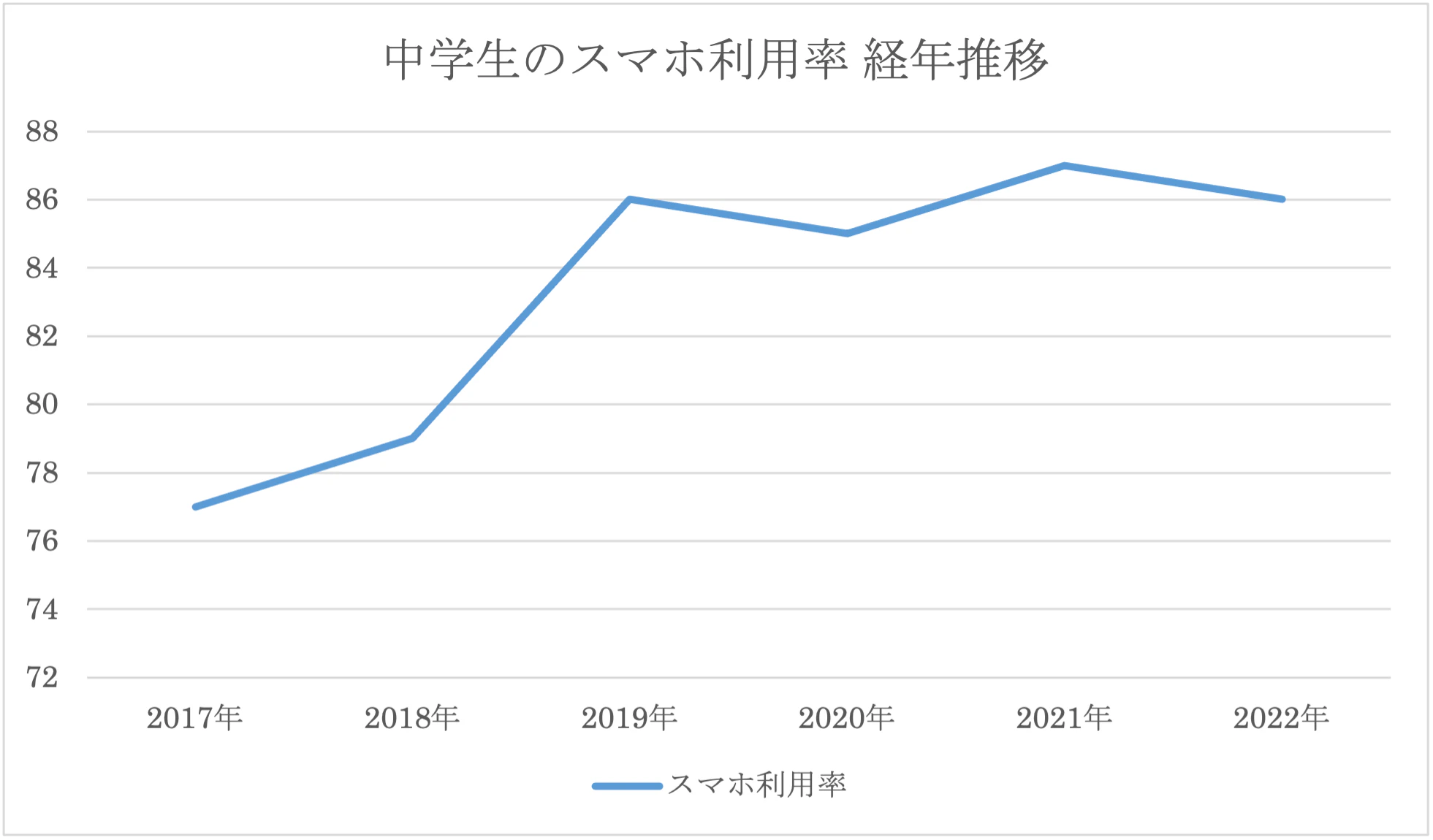
Reference: Smartphone ownership rates reach half of fifth graders and exceed 80% of second-year junior high school students (February 16, 2023) NTT docomo Mobile Social Research Institute website.
Furthermore, smartphone ownership rates are around 60% for first-year junior high school students, but exceed 80% for second- and third-year students.
When comparing smartphone ownership rates between men and women, the results showed that female students tended to have a higher rate of smartphone ownership than male students.
In July 2020, the Ministry of Education, Culture, Sports, Science and Technology issued a document entitled "Regarding the Handling of Mobile Phones in Schools."
While bringing smartphones to junior high schools is prohibited as a general rule, they are permitted under certain conditions as a means of contact in emergencies. However, some schools may have rules separate from the above notice that take precedence, so please check with your school for details.

Giving your middle school child a smartphone has many benefits for both parents and children. Here are some of them.
If your middle school child has a smartphone, it will be easier for them to stay in touch with family and friends.
You can let your family know when you get home from school or if you will be late.
Additionally, it is common for junior high school students to use smartphones to communicate with each other, and smartphones can be said to be an effective tool for building friendships.
Common uses of smartphones by junior high school students include searching and studying.
Giving your junior high school child a smartphone has the advantage of allowing them to supplement their studies at school or cram school by using it to do research or watch educational videos. Even if they don't have time to ask their teacher or parent about something they don't understand, with a smartphone they can quickly look up anything they're curious about on their own.
In this way, giving smartphones to junior high school students can support their learning while reducing the burden on parents.
By using an app that can share location information via GPS, parents can track their child's current location. They can also check the location history. (*1)
Once your child reaches junior high school age, parents may find it difficult to keep track of their child's activities, but being able to check their location on your smartphone when they come home late or go on a trip alone provides peace of mind in terms of crime prevention.
It will be easier for your child to understand if you communicate on a daily basis using LINE or email messages, and only use your smartphone's GPS in emergencies.
*1: The accuracy of location confirmation may be reduced depending on the radio wave environment and GPS satellite environment, such as underground malls, inside buildings, inside vehicles, or in the shadows of buildings.
While there are benefits to giving smartphones to middle school students, there are also some concerns. Here we will introduce some of those concerns.
While social networking sites such as LINE, Twitter, and Instagram allow you to communicate with many people, they also pose the risk of getting caught up in unexpected trouble. For example, interactions between friends or people you meet online can develop into slander.
Junior high school students are still not yet mature enough to build relationships with others, and are unfamiliar with dealing with problems online. Parents need to be very careful about how their children use smartphones.
Smartphones are often used for entertainment purposes such as internet searches and video viewing, so it is likely that the amount of time spent on them will naturally increase. Middle school students, in particular, often find themselves looking at their smartphones even when they know they need to study. Increasing smartphone usage time can easily reduce the amount of time they have to study, which could affect their academic performance.
Furthermore, using your smartphone late into the night can lead to sleep deprivation and disruption of your daily routine.
Once children start having their own smartphones, parents may not notice any problems if their children remain silent.
When giving your middle school child a smartphone, be sure to discuss in advance the risks of using the internet, such as the following:
・Possibility of clicking on fraudulent emails
・Risk of virus infection from browsing harmful websites
・Potential for high charges due to in-app purchases or paid services
・Danger of personal information leaks due to posting on social media or using fraudulent apps
・Possibility of being harmed by malicious individuals targeting minors
To ensure that your middle school-aged children can use smartphones safely, it is important to set rules in advance and create an atmosphere where it is easy to seek advice in case of an emergency.
Here are some specific points.
There are concerns that when junior high school students start using smartphones, they will have less time to study and will be at a greater risk of getting into trouble on social media.
For this reason, it is important to discuss and decide on rules regarding smartphone use as a family in advance. Below are some example rules to set with your middle school child:
・Decide when and where to use your smartphone
・Leave your smartphone with a parent or guardian after a certain time at night
・Limit your interactions on social media to people you have actually met
・Do not use your smartphone during the test validity.
・Do not post photos of yourself on social media without thinking.
・Do not open phishing emails or spam emails
You can easily manage your smartphone usage time by using the "Screen Time" feature on iPhone or the "Digital Wellbeing" feature on Android. Screen Time and Digital Wellbeing allow you to check the amount of time you spend on websites and apps, and you can also set limits on the amount of time you spend on websites and apps.
Another effective way to prevent personal information leaks is to use Norton's paid service, "Dark Web Monitoring." By using this security software, you will be notified via app or email if a leak of personal information is detected, and you will receive support to assist in resolving the problem if you become a victim of fraudulent use.
When deciding on smartphone rules, it is important to respect your child's opinion and discuss them together, rather than unilaterally imposing your own opinion on them.
Once you have established rules for smartphone use, you should also decide in advance how to deal with situations where your child does not follow the rules. For example, you could confiscate the smartphone for a certain validity.
By giving your child strict rules on how to deal with situations when they fail to follow them, they will become more aware of the importance of following the rules when using their smartphone. This is also an important point to prevent serious smartphone problems.
Also, by reviewing the smartphone usage rules as your child grows and gradually relaxing them, your child will be able to learn how to use their smartphone safely. Explain that by following the smartphone usage rules, your child will gain know-how on how to use their smartphone safely, and first make sure they follow the smartphone usage rules you have agreed upon.
It is also important to build a relationship where children feel comfortable talking to their parents about any problems they may have regarding their smartphone use.
Parents and children should communicate with each other on a daily basis, and be prepared to consult or report to parents promptly when problems arise. In order to create an environment where children feel comfortable talking, it is important for parents to always listen and show understanding.
If you're thinking of giving your junior high school child a smartphone, we recommend au 's online-only brand, povo2.0 (*1). Here we'll introduce the benefits of giving your child a povo2.0 smartphone.
*1: All procedures and support will be handled online. Please contact us via the povo2.0 app or official website.
You can use the "Anshin Filter for au "provided by au as a filtering function to protect your children from dangerous websites and apps.
"Anshin Filter for au" has the following features.
・Filtering function to restrict access to sites that are harmful to children
・You can change the strength of filtering depending on your child's age and smartphone usage.
・You can set usage time periods to prevent excessive smartphone use
In addition to the filtering function, "Anshin Filter for au" also allows you to check daily usage time and usage status.
Parents can remotely manage their children's smartphones by registering their own email address as the administrator in the "Anshin Filter for au" app installed on their children's smartphones.
Follow the steps below to set up "Anshin Filter for au." The app is compatible with both iOS and Android.
① Install the app on your child's smartphone and register for the service.
② Parents can register as administrators and set an administrator ID (email address) and password so that they can manage their children's smartphones.
③ "Anshin Filter Administrator Page" You can change your child's smartphone usage time, filtering level, and set permissions and restrictions for each website and app.
Giving your middle school child a smartphone makes it easier to contact them when needed. Also, having your child's own smartphone has the added benefit of allowing them to quickly look up anything they don't understand at school or cram school.
On the other hand, concerns about letting children have smartphones include the risk of trouble due to social media use and the possibility of children not being able to concentrate on their studies. Basically, parents and children should discuss and decide on rules and how to deal with situations if they are not followed. It is also important to take measures such as creating an atmosphere where children feel comfortable calling for help from their parents in case of an emergency.
povo2.0 is an online-only brand from au (*2) with a basic fee of 0 yen (*3) (*4) (*5), and you can use au 's "Anshin Filter for au." Not only can you use the comprehensive filtering functions, but you can also manage smartphone usage time and usage. These functions will give parents peace of mind when letting their children use smartphones.
In addition, with povo2.0, children can purchase as much data capacity (gigabytes) as they want, when they want, allowing them to use their smartphone in a way that suits them. Parents who are thinking of giving their junior high school child their first smartphone should definitely consider povo.
*2: All procedures and support are online. povo2.0 Please contact us through the application or the official website. 3: If there is no purchase of paid Topping for more than 180 days, the use of the service may be suspended or the contract may be terminated.
5 lines under the same name (*) For the cumulative sixth line and thereafter, a contract administration fee of tax included 3,850 yen/line will be charged.
*Includes lines that have been terminated or cancelled by the Company within the past year.
Reference: "povo2.0 Plan Details" (povo)
4: For Data Only, initial Topping purchase is required at the time of contract. Calls+Data For domestic calls: tax included 22 yen/30 seconds Some calling charges may differ, such as calls to satellite phones. For more information The company will charge a specified rate for calls to the following numbers. In addition, designated call charges will apply to phone numbers set by other companies to fees. Sending domestic SMS: tax included 3.3 yen/text (up to 70 characters) Receiving: Free Up to 670 full-width characters can be sent depending on the model. However, up to 134 characters will be charged for two SMS, and after that, one SMS will be charged for every 67 characters. *5: When 0 yen and 0 GB, the maximum sending/receiving speed is 128 kbps.
The names of products and services mentioned in this article are trademarks or registered trademarks of the respective companies. iPhone is a trademark of Apple Inc. registered in the U.S. and other countries. iPhone trademark is used under license from Aiphone Co.
TM and (C) 2023 Apple Inc. au is a registered trademark of KDDI Corporation. Twitter" is a trademark or registered trademark of Twitter, Inc. Instagram is a registered trademark of Facebook, Inc. LINE" is a trademark or registered trademark of LINE Corporation. NTT docomo is a registered trademark of Nippon Telegraph and Telephone Corporation. The iOS trademark is used under license from Cisco in the United States.