The areas where 5G (*1) communication is possible are expanding, and compatible models are appearing one after another. However, some people may not be aware of how 5G (*1) will make things like using smartphones more convenient.
In this article, we will introduce what 5G (*1) is and the benefits of having a 5G (*1) compatible smartphone (hereinafter referred to as a 5G smartphone).
*1: 5G is available in some areas. For more information, please visit the website below.
Reference "area" (povo)

5G (*1) is an abbreviation for "5th Generation," meaning the fifth generation of the next-generation communication standard used for smartphones, mobile phones, and other devices. In Japanese, it is sometimes called the "5th generation mobile communication system." 5G (*1) services began in some areas in March 2020. Currently, the coverage area is expanding, and compatible models are being developed and sold.
*1: 5G is available in some areas. For more information, please visit the website below.
Reference "area" (povo)
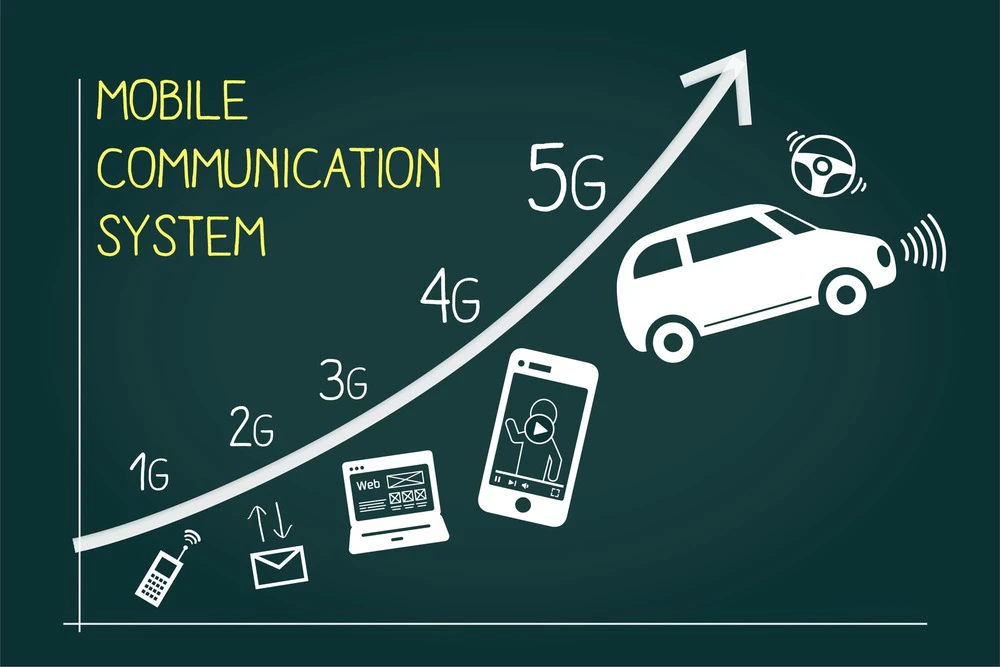
As the term "5th generation mobile communication system" suggests, before 5G (*1) communication standards called "1G" to "4G" were used. We will introduce the history of mobile communication systems leading up to 5G (*1) (*2).
*1: 5G is available in some areas. For more information, please visit the website below.
Reference "area" (povo)
*2: Reference: "Evolution of Mobile Communication Systems and Their Impact" (Ministry of Internal Affairs and Communications)
Analog radio communication began. Originally, this technology was used to enable calls inside cars, but it was later used in mobile phones. Due to the high usage fees, it was not widely adopted, but the foundation of mobile communication systems was established.
As the technology evolved from analog to digital, the use of data communication on mobile phones began in earnest. 1G was mainly for calls, and it wasn't until 2G that email and the internet became available on mobile phones.
Because 1G and 2G were developed for each region of the country, mobile phones purchased in Japan could not be used in other countries. The 3G communication system was created with the aim of standardizing the use of the same terminals worldwide. It also achieved faster communication speeds compared to 2G. The increased speed led to the appearance of mobile phones with cameras, and it was not until 3G that it became possible to send and receive emails with pictures attached.
4G became popular after the iPhone was released in 2007, when smartphones began to become popular. 4G evolved to accommodate the specifications of smartphone communications. Compared to 1G, it offers communication speeds about 100,000 times faster.

5G (*1) is said to have three main features. It's particularly easy to understand if you focus on how much it has evolved from 4G, so let's take a closer look.
It is now possible to transmit large volumes of data at high speeds. While the maximum communication speed with 4G was 110Mbps to approximately 1Gbps, with 5G (*1) it is 10Gbps (target theoretical value) (*2). Downloading a two-hour movie took about five minutes with 4G, but with 5G (*1) it only takes about three seconds. Data communication is approximately 100 times faster.
It is now possible to connect multiple devices simultaneously. With 4G, only a few devices could be connected, but with 5G (*1), approximately 100 devices in the same room can connect to the Internet (*3).
Some people may be experiencing time lag during online meetings or games. 5G (*1) is said to reduce communication time lag compared to 4G, making it possible to perform precise operations on robots and other devices with 10 times the accuracy of 4G (*3).
*1: 5G is available in some areas. For more information, please visit the website below.
Reference "area" (povo)
*3: Reference: "Current and Future Outlook of the Fifth Generation Mobile Communication System (5G)" (Ministry of Internal Affairs and Communications)

Using 5G (*1) has its advantages and disadvantages. Many people would like to know the advantages and disadvantages of 5G (*1) smartphones in particular. First, let's take a closer look at the advantages.
Thanks to the "high-speed, high-capacity" communications of 5G (*1), it is now possible to enjoy high-resolution video such as 4K and 8K on smartphones. In addition, "ultra-low latency" communications will allow you to enjoy sports and live music events without any time lag, making you feel as if you were at the venue.
Viewing VR (Virtual Reality) or AR (Augmented Reality) videos on a smartphone requires a large amount of data. With the advent of 5G (*1), which enables high-speed, high-capacity communications, it is now possible to enjoy VR and AR videos in high quality.
Some people enjoy online games on their smartphones. However, with action games that require immediate control, the time lag can be a real concern. 5G (*1) offers high-speed communication and low latency, allowing you to enjoy games comfortably.
*1: 5G is available in some areas. For more information, please visit the website below.
Reference "area" (povo)

Next, let's take a look at the disadvantages of 5G (*1) smartphones and things to be aware of when switching to 5G (*1).
The 5G (*1) service area is still limited. 5G (*1) service began in March 2020, but it is thought that it will take some time for it to spread to the same extent as 4G. Although it is happening slowly, the 5G (*1) coverage area is expanding. Please check the coverage area of each telecommunications carrier on their respective websites.
To use 5G (*1), you need a smartphone that supports 5G (*1). Although the number of models that support 5G (*1) is increasing, if you plan to use a model that was released recently by inserting a SIM card, be aware that it may not be compatible with 5G (*1) and may not be usable. Please check the dedicated page (*4) for information on povo compatible devices.
Even if you are in a 5G (*1) compatible area and have a 5G (*1) smartphone, you will not be able to use 5G (*1) if your plan is not compatible. 5G (*1) plans may also have higher usage fees than 4G plans. Furthermore, even if you sign up for a 5G (*1) plan, you will not be able to use 5G (*1) once you are outside the compatible area. When purchasing a 5G (*1) smartphone, it is essential to check the plan as well as the compatible area.
*4: Reference: "Compatible models and devices" (povo)
*1: 5G is available in some areas. For more information, please visit the website below.
Reference "area" (povo)

We've introduced 5G (*1), but some of you may be interested in actually using a 5G (*1) smartphone to experience high-quality communications with high speed, large capacity, multiple simultaneous connections, and low latency. If so, we recommend "povo."
*1: 5G is available in some areas. For more information, please visit the website below.
Reference "area" (povo)
povo reduces costs by making procedures and other procedures exclusively online, and offers affordable smartphone plans that are comparable to low-cost SIMs and smartphones. povo2.0 has a basic fees of 0 yen (*5) (*6) (*7), and you can customize your own smartphone plan by adding Topping (paid) that suit you. You can choose Topping based on your data usage and call time.
*5: If you do not purchase any paid Topping for 180 days or more, your service may be suspended or your contract may be terminated. Also, if you have a contract for five lines * under the same name, a contract administration fee of 3,850 yen (tax included included) per line will be charged for the sixth line and beyond.
*This includes lines that have been cancelled or canceled by our company within the past year. If you do not purchase data Topping, the maximum sending and receiving speed will be 128kbps.
Reference: "povo2.0 Plan Details" (povo)
*6: Domestic calls are charged at tax included 22 yen/30 seconds, and sending SMS is charged at tax included 3.3 yen/text (up to 70 characters). Calling rates may differ for some calls, such as calls to satellite phones. For details Click here Receiving SMS is free of charge.
Receiving SMS is free. Depending on the model, up to 670 double-byte characters can be sent. However, up to 134 characters, two SMS will be sent, and after that, one SMS will be sent for every 67 characters.
Reference "povo2.0 Plan Details" (povo)
*7: All procedures and support will be handled online. Please contact us via the povo2.0 app or official website.
povo uses the au network. It not only offers 5G (*1), but also uses au 4G LTE network, which has a population coverage rate of 99.9% (*8), ensuring stable communication quality. Furthermore, the 5G (*1) usage fees is included in Topping, so there are no additional fees. If you're looking to use a 5G (*1) smartphone, we highly recommend considering povo.
*8: "Population coverage rate" is calculated based on areas where communication is possible in 50% or more of the approximately 500m blocks used in the census. Information is current as of the end of December 2020. Content is subject to change. Compatible devices are 4G LTE (800MHz) compatible.
*The names of products and services mentioned in this article are trademarks or registered trademarks of the respective companies.
・iPhone is a trademark of Apple Inc. The iPhone trademark is used under license from Aiphone Co., Ltd.
TM and © 2022 Apple Inc. All rights reserved.
・" au" is a registered trademark of KDDI Corporation.