A balance between income and expenditure is important when managing your household finances. There are several ways to review your household finances, but one easy way is to review your expenses.
Fixed costs are particularly effective for saving money, and communication costs are particularly easy to review. If you're looking to save money, try reviewing your communication costs and managing your household finances in a way that's comfortable for you.
In this article, we will explain the expenses you should check when reviewing your household finances and how to review your communication costs.

When reviewing your household finances, it is essential to review your spending. Household spending can be broadly divided into the following two categories.
・Fixed costs
・Variable costs
We will explain each one in detail.
Fixed expenses are expenses that are paid monthly and have a certain amount. The main examples of fixed expenses are as follows:
・Rent or mortgage
・Water bill
・Utility expenses
・Communication costs
・Insurance premiums
・Automobile-related expenses
・Subscription (flat-rate service) Amount
Few people may reconsider their fixed costs, which do not fluctuate in amount, but if you can reduce your fixed costs, it will lead to efficient savings in the long term.
For example, if you can save 1,000 yen in monthly fixed costs, you can save 12,000 yen per year. If you consider that you can save 60,000 yen over five years, it's a significant amount.
When reviewing your household finances, we recommend that you start by reviewing your fixed expenses.
Variable costs are expenses that increase or decrease in daily life. The main variable costs are as follows:
・Food expenses
・Clothing expenses
・Entertainment expenses
・Entertainment expenses
Unlike fixed costs, which are set at a fixed amount, variable costs can be reduced depending on your willingness to do so. Therefore, many people may have the impression that it is easy to save on them.
However, saving on variable costs requires effort. For example, if you want to save on food costs, you need to make an effort to find supermarkets with the lowest prices possible, shop during discount times, and cook at home more often instead of eating out.
It's important to think about saving money from a long-term perspective, but for some people, the effort to save can be stressful and they may not be able to keep it up for long. If you try to cut variable costs within a reasonable range, you may not get the results you expect, so be careful.
Of all fixed costs, communication costs are one that is easy to cut back on, so we recommend taking a look at them. In particular, when it comes to smartphone bills, you may be signing up for a fees plan that is too high for your actual data usage.
According to the "Recent Trends in the Mobile Market" published by the Ministry of Internal Affairs and Communications in 2020, 42.8% of smartphone users subscribe to plans with a monthly limit of 20GB or more.
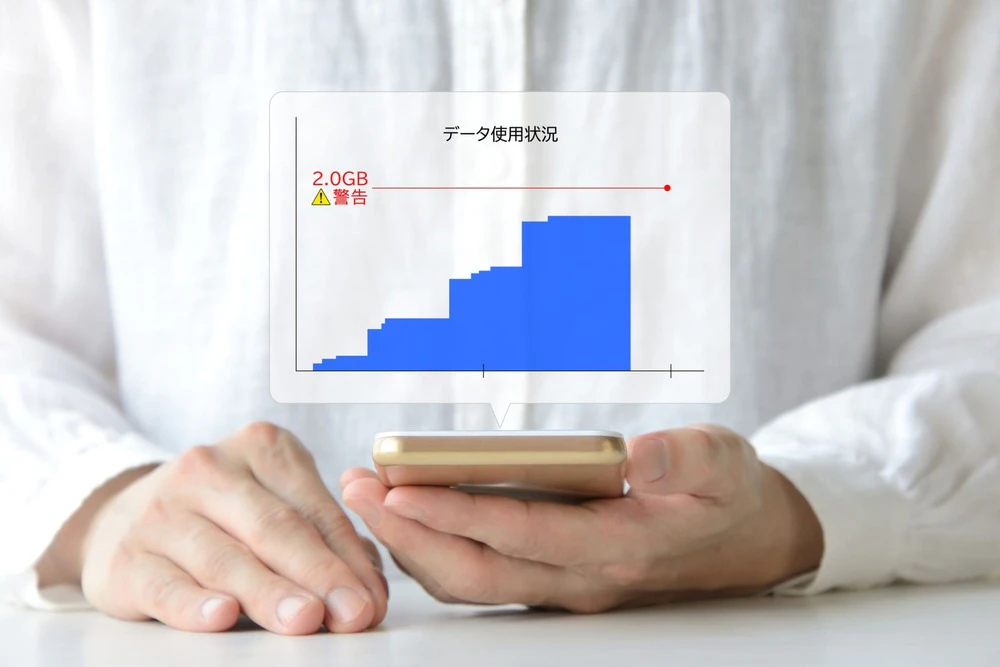
However, when we look at the actual data usage of those who subscribe to plans with a monthly limit of 20GB or more, we find that only 11.3% of users use more than 20GB, and even among those who use more than 10GB, the figure is only 10.4%.
In other words, there is a big discrepancy between fees plan and actual data usage, so many people end up subscribing to plans that are more expensive than they need. Changing your smartphone fees plan can save you more than 1,000 yen per month, and more than 12,000 yen per year, so why not take a moment to check your data usage and reconsider it?
As of October 2021, SIM lock settings have been prohibited in principle, giving users more freedom in choosing their lines, so it may be a good idea to consider changing your telecommunications provider to suit your usage environment.
Source: Ministry of Internal Affairs and Communications "Recent Trends in the Mobile Market" Source: Ministry of Internal Affairs and Communications "About SIM Locks"

Many people may not know whether the smartphone plan they are using is the best for them. We will introduce specific ways to review your plan, so please use this as a reference.
To review your plan, follow these steps:
1. Check your monthly data usage
2. Choose the fees plan that's right for you
3. Remove unnecessary options
Let's take a closer look at each item.
To make the right choice of fees plan for your phone, start by understanding your monthly data usage.
You may be able to check your current or past data usage (except when connected to Wi-Fi) by logging into "My Page" from your carrier's support app or website.
In addition to data usage, you can often see a breakdown of fees usage in My Page. In addition to data usage, optional usage fees such as call charges and answering machine service can also be used as a reference when reviewing your fees plan, so be sure to check them at the same time.
Once you've seen your monthly data usage, it's time to reconsider whether a fees plan is right for you.
A good idea to determine whether a fees plan is right for you is based on the difference between your monthly data usage and the amount of data set for each fees plan.
For example, if your fees plan has a data allowance of 30 GB but your monthly data usage is 20 GB, it is likely that changing to a fees plan with lower data capacity will not interfere with your daily life.
In addition, it may be effective to review your fees plan to take into account other call charges and optional usage fees.
fees Plans vary depending on your carrier. Choose the fees plan that works best for you, including other fees plans from other companies and carriers you currently use.
Smartphone charges include optional Amount you may have subscribed to in addition to data communication fees. There are two main types of options:
・Provided by your current carrier: unlimited calls, voicemail, device compensation service, etc.
・Services provided by other companies: Services that allow you to use content such as music and videos by paying a fixed monthly Amount
You can check and cancel the options of the telecommunications carrier you use from the "My Page" of your current contract with the telecommunications carrier, so if there are any options you don't need, remove them.
If you want to review your fees plan but your monthly data usage varies and you don't know fees plan is best for you, we recommend povo2.0 (※1), which allows you to customize your plan by adding paid Topping.
povo2.0 has a basic fees of 0 yen (*2), but what makes it unique is that there is no concept of a monthly fee, and paid Topping can be added freely. There are a variety of paid Topping, and you don't have to worry about overspending and receiving a large bill later, so you can choose Topping that are best suited to your usage situation.
For example, if you find you need a little more data at the end of the month, you can add an Data Top-up (for 7 days) for 390 yen per use tax included included), or if you watch a long video on the weekend, you can add Unlimited data (24 hours) (※3) for 330 yen per use (tax included included).
Customization with paid Topping reduces data waste, which may also lead to savings on communication costs. Please use this article as a reference and try using povo2.0 (※1).
*1: As this is an online-only plan, all procedures and support will be handled online only. There is no support in store or over the phone. *2: 5 lines under the same name (*) If you sign up, a contract administration fee of 3,850 yen (tax included) per line will be charged for the sixth line and beyond.
*This includes lines that have been cancelled or canceled by our company within the past year. If you have not purchased any paid Topping for 180 days or more, your service may be suspended or your contract may be terminated. When the data plan is 0 yen and 0 GB, the maximum sending and receiving speed is 128 kbps. *3: Communication speeds may be limited during network congestion or when using video or cloud games. *The names of products and services mentioned in this article are trademarks or registered trademarks of the respective companies.
"Wi-Fi", "Wi-Fi CERTIFIED Miracast (TM)", "Miracast (TM)", and "Wi-Fi/Wi-Fi 6" are registered trademarks of the Wi-Fi Alliance.
Name: Misuzu Inoue
Profile: Works as a financial planner, providing easy-to-understand information on "immediately useful money matters" such as household management, introductions to public systems, how to save for education expenses and retirement, scholarships, and investments.
She mainly works as a seminar lecturer at public institutions and provides individual consultations (in person and online) for single mothers and women of child-rearing age.
Qualifications: AFP (certified by the Japan Association of Financial Planners), Type 1 Securities Salesperson