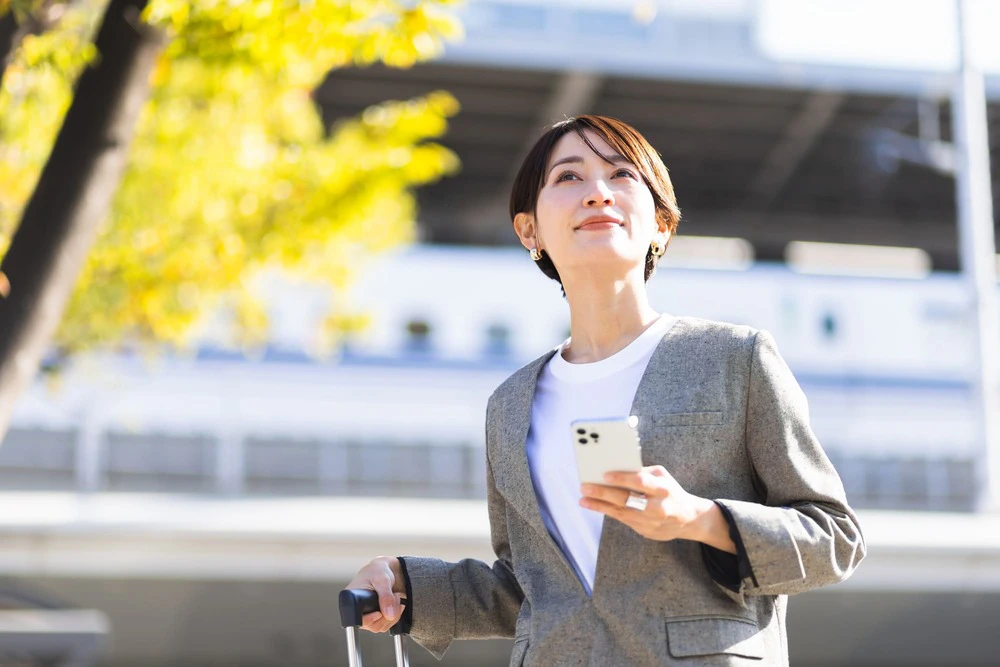
"I enjoy going camping and traveling, but I'm worried about the amount of data I use while I'm there, so I can't use my smartphone to my heart's content." Some of you may have had this experience or thought.
If you are in an environment where you can frequently use Wi-Fi, you rarely have to worry about excessive data usage. However, when you are outdoors, your smartphone usage patterns and data usage may differ from everyday life, such as leaving a map app running for a long time or searching the internet for interesting things.
However, if the frequency is not set, such as "X number of times a month," some people may feel reluctant to change their fees plan or sign up for a special fees, and may be struggling to come up with a solution.
In this article, we will explain how to make the most of your smartphone plan for those who are worried about increased data usage while camping or traveling.
If you frequently use your smartphone's internet connection in places without Wi-Fi and your data usage exceeds the limit of your contract, we recommend that you consider the following measures.
・Change fees plan
・Use the dual SIM function to use a different SIM
First, review fees current plan and, if necessary, consider changing to one that better suits your lifestyle. If you spend a lot of time out, switching to a plan with more gigabytes of data will allow you to use your smartphone without worrying about data usage.
Another option is to use the dual SIM feature to use a different SIM.
Dual SIM is a feature that allows you to use two SIM cards on one smartphone. This means you can use a plan provided by a carrier other than the one you currently use, so you can use a different carrier when you are away from your daily life, such as when camping or traveling.
If you want to use dual SIM, you will need to choose a smartphone that supports dual SIM.
eSIM is a SIM standard that stands for "embedded SIM." It refers to a SIM that is built into the smartphone itself.
While physical SIMs require you to insert and remove a small card, eSIMs can perform a similar function by updating and rewriting information.
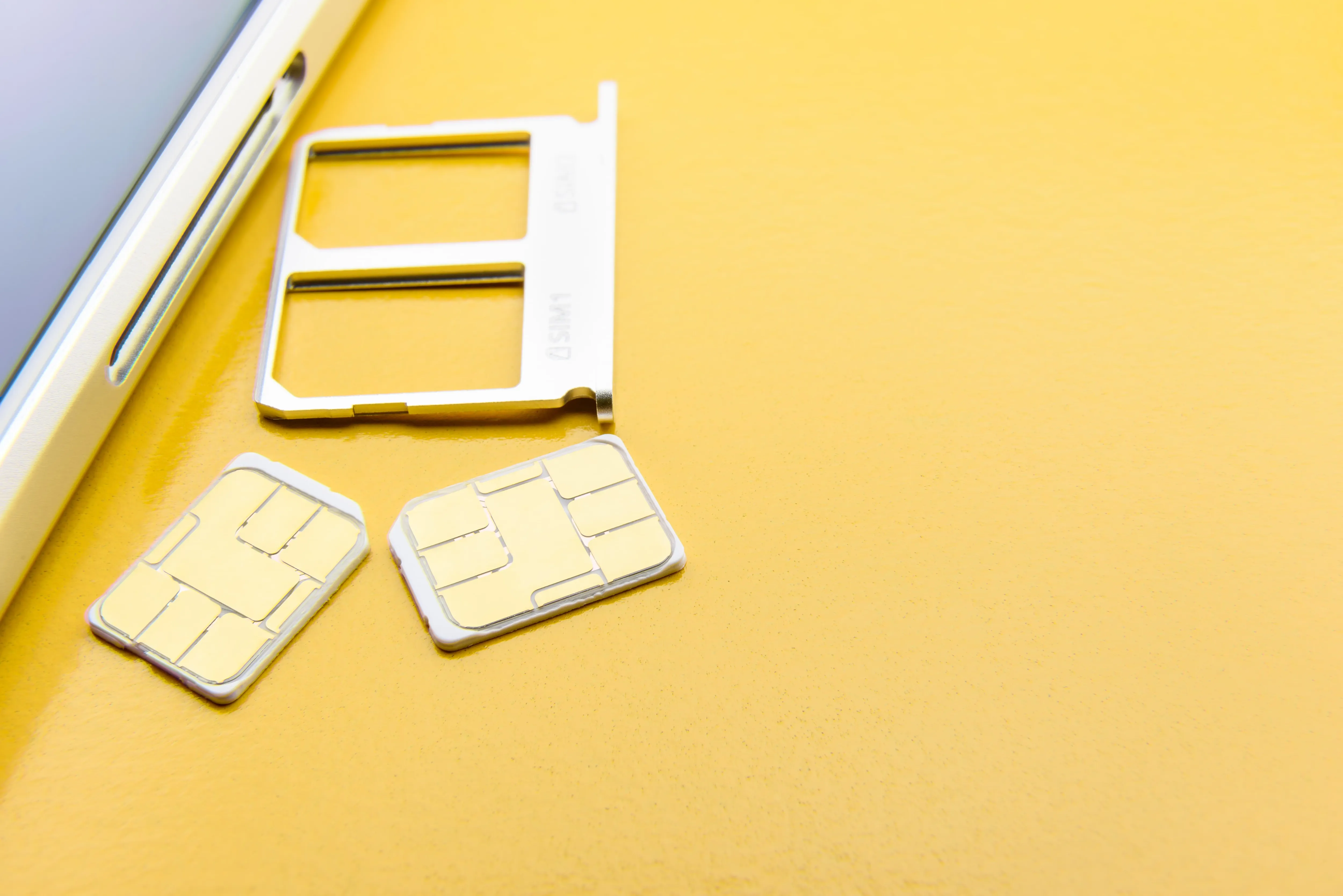
With dual SIM, you can use two SIM cards in one smartphone, and you can receive calls regardless of the phone number linked to either SIM.
However, it is important to note that while you are making a call with one SIM, you cannot use the Internet with the other SIM. This can be resolved by using the same SIM for Internet communication as the one you are using for the call. Note that you cannot make calls with two SIMs at the same time.
With the above conditions in mind, we will explain the detailed differences between the three dual SIM standards. Please consider how to use dual SIM that suits you best.
The first standard we'll introduce is DSDS (Dual SIM Dual Standby). This standard allows you to make calls using two SIMs without having to switch between them. However, one of the SIMs will have high speeds, while the other will have low speeds.
In short, one of the SIM cards will be slow, which will make it difficult to make phone calls and slow down your internet connection.
If you only need high-speed communication on one of the two services, we recommend using DSDS.
*Whether DSDS can be used depends on the model you are using.
Next, we will introduce DSDV (Dual SIM Dual VoLTE).
Unlike DSDS (Dual SIM Dual Standby), this phone allows you to use high-speed internet with two SIMs.No matter where you are, you can enjoy a smooth communication environment for both work-related and personal communications, and is recommended for those who are concerned about DSDS.
*Whether DSDV can be used depends on the model you are using.
DSDA (Dual SIM Dual Active) has one major difference compared to DSDS and DSDV.
This means that you can make a call using one SIM card while using the internet with the other.
For example, when you are waiting to meet up with an acquaintance, you can talk on one SIM card while checking a map online.
And high-speed data is available on both SIM cards.
Reference: "What is Dual SIM (Second SIM)? Explaining the types, advantages and disadvantages" (povo) *Whether DSDA can be used depends on the model you are using.
If you go camping or traveling frequently but find it troublesome to change plans every time you do so, take advantage of dual-SIM and use your phone wisely.
And if you are wondering what carrier you should use for your sub-line (second SIM) when using dual SIM, we recommend povo2.0 (*1), which is an online-only brand of au.
povo2.0 The reasons why we recommend (*1) as a sub-line are as follows.
The fees plan with 0 yen basic fee (*2)(*3)(*4)
Flexible usage is available with Topping (charged).
You may want to keep the cost of a sub line as low as possible compared to your main line.
povo2.0 The fees plan of has a basic fee of 0 yen, and you can add Topping (fee-based) as needed.
If you want to use a sub line but use less data capacity, you can save fees significantly compared to your main line by using Topping for tax included 990 yen per "Data Top-up 3GB (30 days)". In addition, for those who want to use the Internet as much as possible on short validity such as camping or traveling, we recommend tax included 330 yen/time for Unlimited data (24 hours) (*5).
In this way, the appeal of povo2.0 is that you can flexibly use Topping (fee-based) according to your own usage situation.
*1: This is an online-only plan, so all procedures and support are online. povo2.0 Please contact us through the application or the official website. 2: If there is no purchase of paid Topping for more than 180 days, the use of the service may be suspended or the contract may be terminated.
If you subscribe to 5 lines(*) under the same name, a contract administration fee of tax included 3,850 yen/line will be charged for the cumulative 6th line and thereafter.
*Includes lines that have been terminated or cancelled by the Company within the past year. 3: For Data Only, initial Topping purchase is required at the time of contract. Calls+Data For domestic calls: tax included 22 yen/30 seconds Some calling charges may differ, such as calls to satellite phones. For more information The company will charge a specified rate for calls to the following numbers. In addition, designated call charges will apply to phone numbers set by other companies to fees. Sending domestic SMS: tax included 3.3 yen/text (up to 70 characters) Receiving: Free Up to 670 full-width characters can be sent depending on the model. However, up to 134 characters will be charged for two SMS, and after that, one SMS will be charged for every 67 characters.
Reference: povo2.0 Plan Details" (povo)
*4: When 0 yen and 0 GB, the maximum sending/receiving speed is 128 kbps. *5: Communication speed may be limited during network congestion or when using videos, cloud games, etc.
Some people often go camping or travel, but worry about data usage and communication costs and are unable to use their smartphones to their heart's content.
By using the dual SIM function of the smartphone you currently use, you may be able to use your smartphone in a way that suits your style.
When using dual SIMs, we recommend povo2.0 (*1) as a secondary line. It is a highly flexible and convenient service that allows you to add Topping (for a fee) according to your usage.
Dual SIM is only available on compatible models, so be sure to check before signing up for a secondary line, but why not consider using it?
Reference: "Compatible models and devices" (povo) *1: As this is an online-only plan, all procedures and support will be handled online. Please contact us via the povo2.0 app or official website.
Name: Takehiro Ide
Profile: While holding a nursing qualification, she worked in sales at a Tokyo Stock Exchange prime housing manufacturer and an IT venture company before joining an editing production company. With experience in website construction, video editing, and marketing, she is now the head of the editing department and is involved in directing owned media for megabanks, server-related companies, and recruitment agencies. She also runs a YouTube channel as a hobby.
Website: https://takeblog.org/


%20rotate(-90)'%20fill='%23fffa00'/%3e%3c/svg%3e)
%20rotate(-90)'%20fill='%23333'/%3e%3c/svg%3e)