By switching from a telecommunications carrier to a low-cost SIM, you can reduce your monthly smartphone fees and therefore your monthly fixed costs.
However, there are many types of low-cost SIM cards, and many people may be wondering, "I don't know which company to choose!"
In this article, the author, who has eight years of experience in the telecommunications industry, will answer questions you may have when choosing a smartphone or telecommunications provider.
We have compiled basic information such as "What is a low-cost SIM card?", frequently asked questions, and points to consider when choosing one, so please use this as a reference.
First, let's take a look at what a low-cost SIM is.
A low-cost SIM is a service that rents lines from telecommunications carriers such as au, docomo, and SoftBank and provides them to users at a low price.
Companies that offer low-cost SIM cards are called "MVNOs."
MVNOs do not own the base stations required to provide lines, but instead rent equipment from telecommunications carriers, which allows them to offer services at low cost.
In this chapter, the author, a former smartphone salesperson, will answer frequently asked questions.
Please use this as a reference if you are having trouble choosing a low-cost SIM or if you are wondering whether to get a low-cost SIM at all.
The two main reasons why low-cost SIM fees are so affordable are:
・No maintenance costs for the base stations that provide the lines
・They often do not have physical stores, which helps keep labor costs down
As mentioned above, MVNOs rent lines from telecommunications carriers, which means there is no maintenance for base stations and no upkeep costs.
Furthermore, most low-cost SIM cards are applied for online, and some operators do not have physical stores. The lack of rental fees and labor costs is one of the reasons they can offer their services at such low prices.
Low-cost SIM cards support MNP (Mobile Number Portability), which means you can keep your current phone number.
| Application type | Whether or not you can transfer your phone number |
|---|---|
| New | Cannot transfer (new number) |
| MNP (switching from another carrier) | You can carry over your current phone number |
In order to keep your current phone number, you will need to obtain a 10-digit "MNP reservation number" and apply for a low-cost SIM before applying.
Please be careful, as if you accidentally apply as a "new" customer, you will not be able to keep your phone number.
Please note that the method for obtaining an MNP reservation number varies depending on the telecommunications company you are currently using, so be sure to check before proceeding with the procedure.
Even if you switch to a low-cost SIM, you can continue to use your compatible smartphone.
Be sure to check the official website of the low-cost SIM you are switching to in advance to see if your current model is compatible.
Smartphones purchased from a telecommunications carrier may be set up so that they cannot be used with lines other than that of that company.
This is called a SIM lock, and unless you unlock it, you will not be able to use the device (smartphone or tablet) you want with another carrier. By unlocking the SIM lock, you will be able to use any SIM card from any carrier.
The SIM unlocking procedure is simple; all you need to do is request it from your carrier. The procedure for unlocking the SIM may vary depending on the carrier, but please note that there is a fee if you do it in-store.
In addition, for devices sold after October 1, 2021, SIM locking is prohibited as a general rule, so there is no need to go through the SIM unlocking process.
Reference: "What is SIM unlocking? A detailed introduction to the advantages and disadvantages, and how to unlock it" Reference: "Is SIM unlocking necessary when using povo2.0? A detailed explanation for each case"
Some people who are considering using a low-cost SIM card for the first time may be worried that the communication speed of a low-cost SIM card will be slow.
Although it depends on the smartphone usage environment and contract status, communication speeds tend to be slower during times when the lines are congested, such as at night when there are many users.
As mentioned above, low-cost SIM cards rent lines from telecommunications companies, and the available network is limited.
However, in situations where high-speed communication is possible, such as during off-peak hours, there is a high possibility that you will be able to enjoy stable communication at a level comparable to that of a telecommunications carrier.

The following five points are important when choosing a low-cost SIM card.
1. Compatible lines
2. Monthly fees
3. Communication speed
4. Data capacity
5. Campaign details and conditions
Let's take a look at each of these points.
| Compatible lines | An example of a low-cost SIM |
|---|---|
| au network | J:COM MOBILE, BIGLOBE Mobile, etc. |
| docomo line | OCN Mobile ONE, IIJmio, etc. |
| SoftBank line | mineo etc. |
If you're unsure which low-cost SIM to choose, be sure to check the compatible lines.
For example, "J:COM MOBILE" and "BIGLOBE Mobile" use the au network, while "OCN Mobile ONE" uses the docomo network.
When choosing a low-cost SIM, it's important to check whether the monthly fees fits within your monthly budget.
Low-cost SIM cards have lower monthly fees than telecommunications carriers, but even for plans that offer the same amount of data, fees vary depending on the carrier.
When comparing low-cost SIM cards, choose a provider that offers a fees plan that fits your budget.
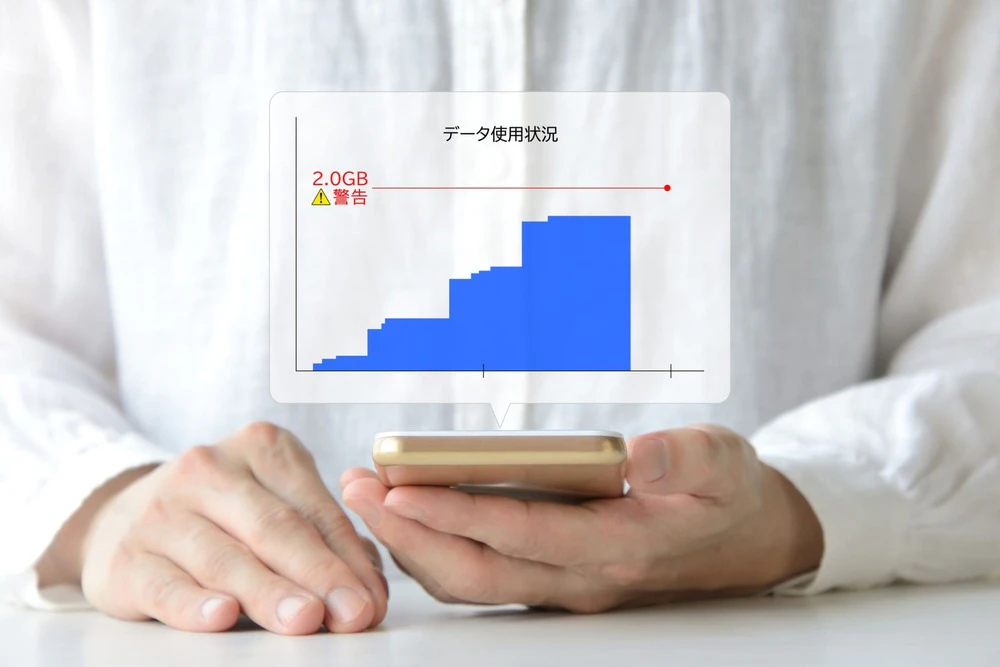
You should also check the amount of data you are consuming on your personal page.
Some providers offer plans ranging from small to large data capacities, but if you don't know how much data you normally use, you may end up choosing a data capacity that doesn't suit you, which could result in higher monthly fees or slower speeds at the end of the month due to speed restrictions.
You can choose the appropriate plan by looking at how much data you have used over the past three months.
If the amount of data you use fluctuates from month to month, we recommend povo2.0, au 's online-only brand that allows you to purchase data capacity according to your needs.
It is also important to check the campaign details and conditions, such as cash back or discount offers.
Depending on the campaign and the user, it may be validity open until the cash back or points are awarded, or it may be mandatory to subscribe to additional options. When comparing cheap SIM campaigns, etc., in addition to the amount of discount during validity, compare and contrast how long the discount will be applied, what fees it will be after validity ends, and what fees it will cost when you cancel, and make sure to check the contents and conditions carefully so as not to leave any uncertainties.
If you're having trouble choosing a low-cost SIM, we recommend au 's online-only brand, "povo."
・You can Topping as you want, whenever you want.
・There is a set plan with video services
・Supports eSIM (※1)
・#Get gigabytes with gigaactivities
Reference: "#Gigakatsu" (povo)
・Free tethering
Online only fees plans povo2.0 then basic monthly fees is 0 yen (*2)(*3)(*4)(*5) The following is a list of the most common problems with the "C" in the "C" column.
Data Topping and calls Topping can be Topping as needed.
For example, "If you make phone calls but rarely use the Internet, Data Top-up 3GB (30 days) tax included 990 yen/time and unlimited calls within 5 minutes (tax included 550 yen) (*6) use" and "If you are on a business trip and want to use plenty of tethering throughout the day Unlimited data (*7) (24 hours) tax included 330 yen/times to Topping" and so on, which can be flexible depending on usage.
In addition, povo2.0 is not an MVNO but an online-only brand of au, so the network quality is the same as au even at night and during other times of the day when communication is congested.
Since au lines with a certain level of communication stability are available, those who are considering switching to a low-cost SIM for the first time need not be concerned about communication quality.
If you are unsure about choosing a low-cost SIM, consider povo, an online-only plan for au that allows you to choose Topping in your own way.
*1: Only for eSIM-compatible devices. *2: Since this is an online-only plan, all procedures and support will be online. povo2.0 Contact us through the app or official website. *3: Additional fees such as fees may apply. If you have not validity purchased a paid Topping for more than 180 days or more, you may be suspended or terminated from the contract. Please note.
If you sign up for 5 lines (*) under the same name, a contract administration fee of tax included 3,850 yen/line will be charged after the 6th line in total.
*Including lines that have been canceled or canceled by our company within the past 1 year *4: Calls to Japan will cost tax included 22 yen/30 seconds, and SMS calls will cost tax included 3.3 yen/message (up to 70 characters). Depending on the model, it can transmit up to 670 characters in full width. Up to 134 characters are counted as 2 letters, and after that, a transmission fee of 1 letter will be charged for every 67 characters. Some call charges, such as calls to satellite phones, may vary. Click here for details. *5: If you do not purchase data Topping, the maximum transmission and reception will be 128kbps. *Calls to phone numbers set by other companies starting from 6:0570 (navigation dial, etc.) fees, number guidance (104) (number guidance fees are not free, call fees are free), government 1XY service (188), #ダイヤル (quick dial), SMS sending, calls to satellite phones, Calls to telephone numbers separately designated by the Company are not eligible for free calls by this Topping. International calls and calls made and received from overseas are also not eligible. Call charges are charged according to the service.*7: The communication speed may be limited during network congestion or when using video, cloud games, etc.
Belorika @ Low-cost SIM blogger
·profile
A part-time office worker living in Kanagawa Prefecture and working in Tokyo.
After graduating from a private university, he joined an electronics retailer as a new graduate and worked as a smartphone sales representative.
He has been involved in the smartphone industry for about 10 years, serving as a top salesperson and area manager, and has experience reviewing the smartphone and fixed-line plans of many customers.
He is currently using his experience to provide information that helps households save money through low-cost SIM cards.
Twitter: Belorika https://twitter.com/bero_rika
Management blog: https://berorika.com/